When selecting methods, consider your evaluation’s objectives and the type of information you want to gather. For example, if you want to understand how participants feel about the programme, you might conduct interviews to hear their perspectives. If measuring the programme’s overall impact is your goal, surveys can help collect data from many people quickly.
Creative methods like arts-based approaches are also useful for engaging participants and collecting rich, unique insights in a less formal setting. The following are some recommended data collection methods that can be used individually or together:
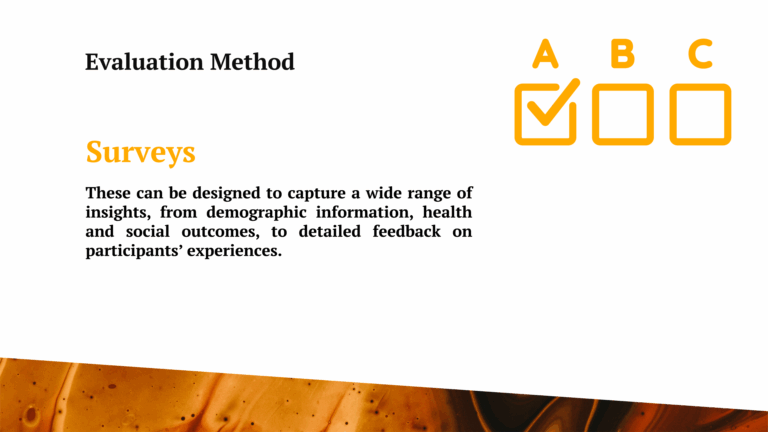 Examples of measures that can be included in a questionnaire for participants.
Recommended key outcome measures
- Life satisfaction (for example measured with the Single-item Life Satisfaction measure)
- Mental wellbeing (for example measured with the Short Warwick-Edinburgh Mental Wellbeing Scale (SWEMWBS))
- Loneliness (for example measured with T-ILS (UCLA 3-item).
Additional outcome measures that may also be considered for inclusion
Anxiety/depression symptoms (for example measured with the Patient Health Questionnaire 4 item scale (PHQ-4))
- Sleep problems (for example measured with the item 3 from the PHQ-9 depression scale)
- Stress (for example measured with the single-item Perceived Stress Scale)
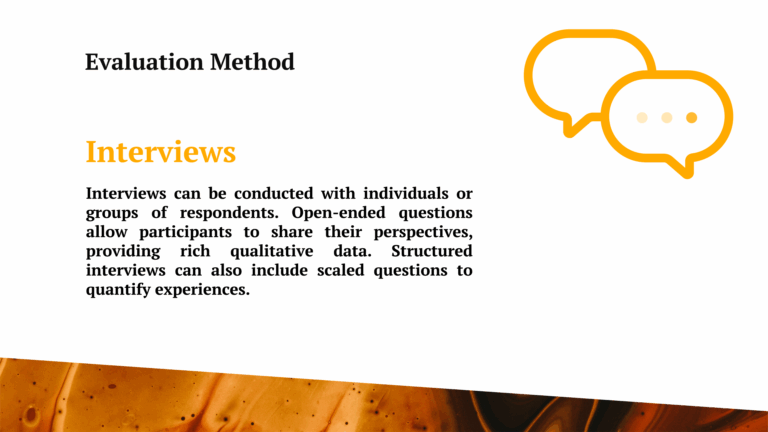
Examples of Open-ended questions – “Please share one or more specific activities or moments that stood out to you during your participation in the AoP programme”.
Examples of structured interviews “On a scale from 1 to 10 how do you rate …”.
Examples of interview questions for participants.
The following questions may be used to assess the perception of the AoP programme by the participants:
- How did you hear about the AoP programme?
- What was your initial reaction when you learnt about it?
- What did you like/not like about the AoP programme?
- How satisfied are you with the service/programme?
- What benefits did you experience from the AoP programme?
- Did you experience any changes in your life?
- Did you experience any difficulties in meeting with the link worker?
- Did you find the link worker to be helpful? Why/why not?
- How convenient was it for you to participate in the prescribed arts and cultural activities?
- How could your experience with AoP could be improved?
(adapted from the WHO Toolkit on How to Implement Social Prescribing).
Examples of interview questions for stakeholders implementing an AoP programme
The following questions may be used to assess the AoP programme from the perspective of health providers and link workers:
- How many participants did you refer to the AoP programme last week/ month/year?
- How many of these participants were satisfied with the programme?
- Do you think that the participants that you referred benefited from the AoP programme?
- What are the main challenges you have encountered in referring people to the link worker/AoP programme?
Arts-based/creative methods: Arts-based and creative approaches can be applied especially at the data collection and dissemination phases of the evaluation cycle. They include a wide variety of techniques including e.g. photography, visual arts, and creative writing. Arts-based and creative approaches are often well received by the participants and can be experienced as less intrusive than e.g. more clinically based evaluation tools.
Your evaluation questions should address key aspects of programme performance and outcomes. Examples include assessing changes in participant mental wellbeing, the convenience of accessing the programme, and overall satisfaction.